Product Advantages
Structural and Design Excellence in Compact Format
The ZED-F9P/IST8310 module features a thoughtfully engineered form factor optimized for field deployment as a GNSS RTK module for surveying and centimeter level positioning module. Its modular GH1.25 6-pin connector enables straightforward installation into existing rover or base station systems. The design integrates an IST8310 compass directly within the GNSS framework, eliminating the need for external heading sensors. Supported multi-constellation reception (GPS, GLONASS, Beidou, and Galileo) and 184 channels maximize satellite visibility for consistent positional updates. The product’s robust anti-interference structure ensures signal integrity across challenging terrains, meeting industrial integration demands for real-time, precise rover positioning.
Enhanced Performance and User-Centric Usability
Leveraging advanced dual-frequency RTK technology, this RTK module for rover station provides exceptional performance with centimeter-level accuracy and fast initialization times. Users benefit from multiple configurable update rates (0.25 Hz to 10 Hz), allowing flexible adaptation for varying operational needs. The embedded IST8310 compass supports heading calculation, improving rover navigation and mapping accuracy. Low power consumption and compact weight ensure practical mobility in remote survey sites. With support for multiple output protocols, it facilitates easy integration into professional workflows, providing operators with reliable real-time position data and essential orientation, streamlining daily surveying and rover operations.
丨 Product Introduction
Centimeter level high precision: using carrier phase difference to achieve precise positioning, suitable for high-precision scenarios such as surveying and autonomous driving.
Multi constellation compatibility: It can simultaneously receive signals from multiple satellites such as GPS and Beidou, enhancing positioning stability in complex environments.
Quick positioning startup: The chip has efficient computation, quickly solves ambiguity, greatly reduces initialization time, and improves efficiency.
Strong anti-interference ability: adopting special design to effectively resist electromagnetic interference and signal obstruction, ensuring reliable positioning.
丨 Specification parameters
|
Chip characteristics
|
chip
|
UBLOX-F9P
|
|
working frequency
|
BDS: B1 B2
GPS: L1 L2
GLONASS: G1 G2
GALILEO: E1 E5b
QZSS: L1 L2
|
|
Receiving channel
|
184 search channel
|
|
Sensitivity
|
track
|
-167 dBm
|
|
Re capture
|
-160 dBm
|
|
cold boot
|
-148 dBm
|
|
Hot start
|
-157 dBm
|
|
First positioning time TTFF
|
cold boot
|
26s
|
|
Hot start
|
2s
|
|
Re capture
|
2s
|
|
Accuracy
|
RTK horizontal accuracy
|
0.01 m + 1 ppm CEP
|
|
RTK vertical accuracy
|
0.01 m + 1 ppm CEP
|
|
Single point horizontal accuracy
|
1.5m CEP
|
|
Single point vertical accuracy
|
1.5m CEP
|
|
Speed accuracy
|
0.05m/s
|
|
1PPS time accuracy
|
RMS 30ns
|
|
99% 60ns
|
|
Convergence time
|
Convergence time
|
≤10s
|
|
Output data
|
Baud rate
|
38400bps (default) [Optional: 4800-921600]
|
|
Output interface
|
TTL
|
|
Output Protocol
|
NMEA0183,RTCM 3.3,UBX
|
|
update frequency
|
Default 1Hz (0.25Hz-10Hz)
|
|
Carrier phase output
|
Support, output RAWX statement
|
|
FLASH
|
built-in
|
|
Working conditions
|
height
|
<50,000m
|
|
speed
|
500m/s
|
|
Gravitational acceleration
|
≤4g
|
|
Electrical
specifications
|
working voltage
|
3.3V-5V DC
|
|
power waste
|
<300mW @3.3V
|
|
Physical parameters
|
size
|
Φ86*22mm
|
|
weight
|
145g
|
|
Connector
|
GH1.25 6pin self-locking connector
|
|
Environment
|
working temperature
|
-35℃+80℃
|
|
Storage temperature
|
-40℃-+85℃
|
|
Compass
|
Compass
|
IST8310
|
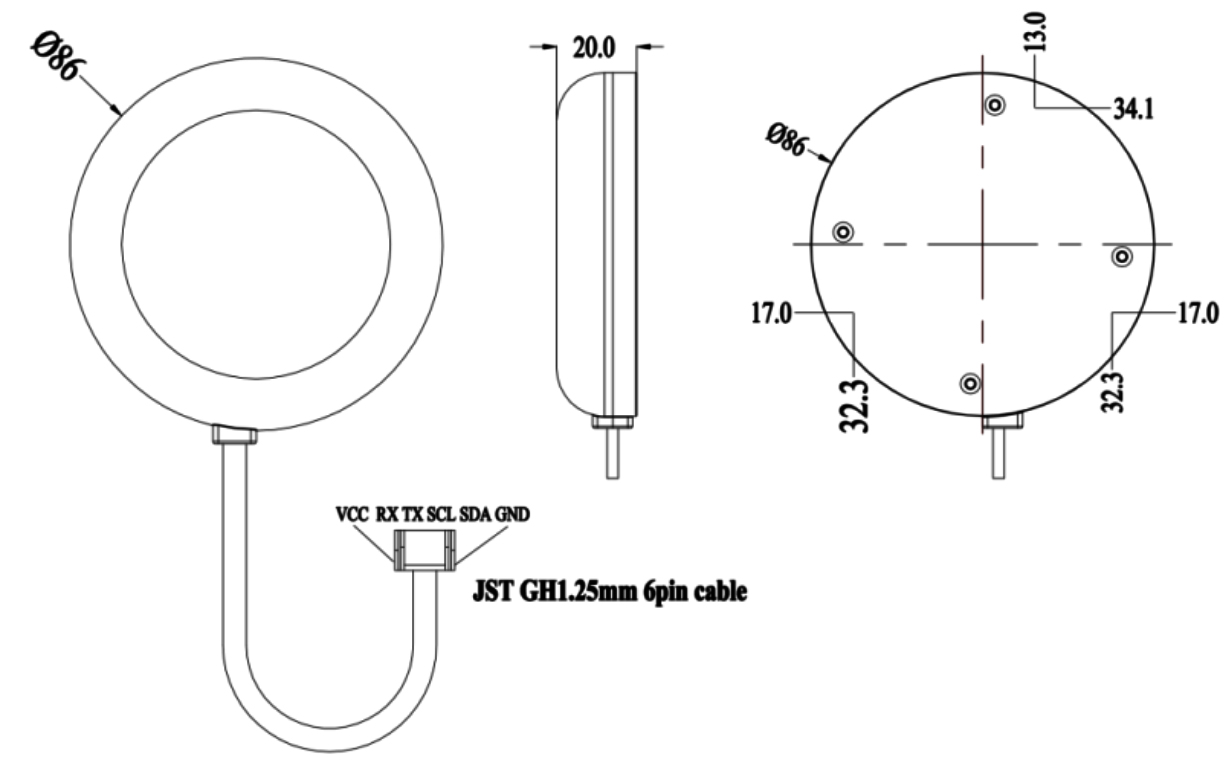
Table 1 PIN Function
|
No.
|
Name
|
Signal Description
|
|
1
|
VCC
|
Main power input, +3.3V~5V
|
|
2
|
RX
|
Receive – This pin is used in serial communication to receive data from another device.
|
|
3
|
TX
|
Transmit – This pin is used in serial communication to send data to another device.
|
|
4
|
SCL
|
Serial Clock – In the I²C communication protocol, this is the clock signal line used to synchronize data transmission.
|
|
5
|
SDA
|
Serial Data – In the I²C communication protocol, this is the line used for data transmission.
|
|
6
|
GND
|
Ground pin, used for connecting to the circuit's ground, providing the reference voltage needed for the circuit loop.
|
|
Note: Typically, VCC and GND are used to supply power, TX and RX are used for serial communication, and SCL and SDA are used for I²C communication. These interfaces allow the receiver to supply power and exchange data with external devices.
|

Use Scenarios
Precise Field Surveying and Stakeout Operations
In field surveying projects, this GNSS RTK module for surveying plays a crucial role by providing real-time precise positions and heading data critical for stakeout and boundary verification. It operates efficiently within diverse outdoor environments such as construction sites, agricultural fields, or infrastructure corridors. The module’s multi-constellation support and interference-resistant design guarantee continual satellite signal tracking essential for centimeter-level positioning. Surveyors and rover operators can integrate the module into existing rover station workflows to expedite data collection, improve spatial accuracy, and ensure compliance with industry standards for geospatial positioning.
Integration into Mobile Mapping and Geodetic Surveying Platforms
This centimeter level positioning module is well suited for mobile mapping applications and geodetic baseline establishment, particularly in industries requiring high-accuracy spatial information like construction, rail, and road surveying. The inclusion of a GNSS module with compass capability ensures precise heading orientation is available alongside location data, streamlining route mapping and corridor assessments. Its adaptable configuration supports both rover and base station modes, enabling seamless integration into comprehensive RTK workflows. The quick startup and stable carrier-phase measurements reduce operational downtime, enhancing productivity in professional mobile measurement and mapping systems.
FAQ
What makes your GNSS RTK module suitable for surveying applications?
Our GNSS RTK module for surveying, including the ZED-F9P/IST8310, offers centimeter-level positioning accuracy, multi-constellation support, and fast initialization. These features ensure precise, reliable positioning critical for field surveying and mobile data collection.
Can I customize the RTK module for rover station setups?
Yes, we provide flexible OEM/ODM options for our modules, allowing customization tailored to your specific RTK module for rover station application. Our technical team supports firmware adjustments and system integration to meet diverse operational needs.
How do I install and connect the GNSS module?
The ZED-F9P/IST8310 module uses a compact GH1.25 6-pin connector for easy integration. Operating at 3.3–5 V with low power consumption, it supports multiple output protocols, simplifying installation on rover platforms for accurate real-time positioning.
What kind of after-sales support do you offer for your GNSS modules with compass?
We offer comprehensive after-sales services, including firmware updates, technical consulting, and lifetime product documentation. Our support ensures your GNSS module with compass maintains optimal performance throughout its operational life.





