Product Advantages
Structural Integrity and Modular Flexibility
Engineered with a compact design measuring just 45 × 11.5 mm and weighing 35.8 g, the product facilitates easy embedding within compact UAV flight controllers or custom robotics platforms. The module’s multi-protocol interface—including TTL serial, NMEA0183, RTCM 3.3, and UBX—ensures compatibility with diverse avionics and control ecosystems, enhancing modular system integration. Additionally, its robust temperature tolerance from -35℃ to +80℃ supports reliability in challenging field deployments. Overall, this RTK module combines a sleek, integrated design with flexible architecture, making it an efficient choice for complex system builds requiring a multi system GNSS module.
Performance Excellence and User-Centered Value
The ZED-F9P delivers outstanding RTK positioning precision of 0.01 m horizontal and vertical accuracy combined with rapid initialization times under 10 seconds, enabling prompt high-precision fixes that enhance operational efficiency. The integrated IST8310 compass adds vital heading data, simplifying orientation determination and improving navigation accuracy. With update rates configurable up to 10 Hz, users benefit from smooth positional data streams for dynamic flight maneuvers. Operating over a wide voltage range (3–5.5 V) and ensuring seamless compatibility with standard autopilot software, this centimeter level RTK module offers superior usability and practical value for precision navigation tasks.
丨 Product Introduction
1. High precision positioning: With the help of RTK technology, centimeter level accuracy can be achieved.
2. Multi constellation collaboration: compatible with multiple satellite navigation systems, strong signal reception.
3. Rapid positioning convergence: Achieve high-precision positioning in a short period of time.
4. Integration convenience: Small size, easy to embed into various devices.
丨 Specification parameters
|
Chip characteristics
|
chip
|
UBLOX-F9P
|
|
working frequency
|
BDS: B1 B2
GPS: L1 L2
GLONASS: G1 G2
GALILEO: E1 E5b
QZSS: L1 L2
|
|
Receiving channel
|
184 search channel
|
|
Sensitivity
|
track
|
-167 dBm
|
|
Re capture
|
-160 dBm
|
|
cold boot
|
-148 dBm
|
|
Hot start
|
-157 dBm
|
|
First positioning time
TTFF
|
cold boot
|
26s
|
|
Hot start
|
2s
|
|
Re capture
|
2s
|
|
Accuracy
|
RTK horizontal accuracy
|
0.01 m + 1 ppm CEP
|
|
RTK vertical accuracy
|
0.01 m + 1 ppm CEP
|
|
Single point horizontal accuracy
|
1.5m CEP
|
|
Single point vertical accuracy
|
1.5m CEP
|
|
Speed accuracy
|
0.05m/s
|
|
1PPS time accuracy
|
RMS 30ns
|
|
99% 60ns
|
|
Convergence time
|
Convergence time
|
≤10s
|
|
Output data
|
Baud rate
|
38400bps (default) [Optional: 4800-921600]
|
|
Output interface
|
TTL
|
|
Output Protocol
|
NMEA0183,RTCM 3.3,UBX
|
|
update frequency
|
Default 1Hz (0.25Hz-10Hz)
|
|
Carrier phase output
|
Support, output RAWX statement
|
|
FLASH
|
built-in
|
|
Working conditions
|
height
|
<50,000m
|
|
speed
|
500m/s
|
|
Gravitational acceleration
|
≤4g
|
|
Electrical specifications
|
working voltage
|
3V-5.5V DC
|
|
power waste
|
<180mW @3.3V
|
|
Physical parameters
|
size
|
Φ45*11.5mm
|
|
weight
|
35.8g
|
|
Connector
|
GH1.25mm 8-pin
|
|
Environment
|
working temperature
|
-35℃+80℃
|
|
Storage temperature
|
-40℃-+85℃
|
|
Compass
|
Campass
|
IST8310
|
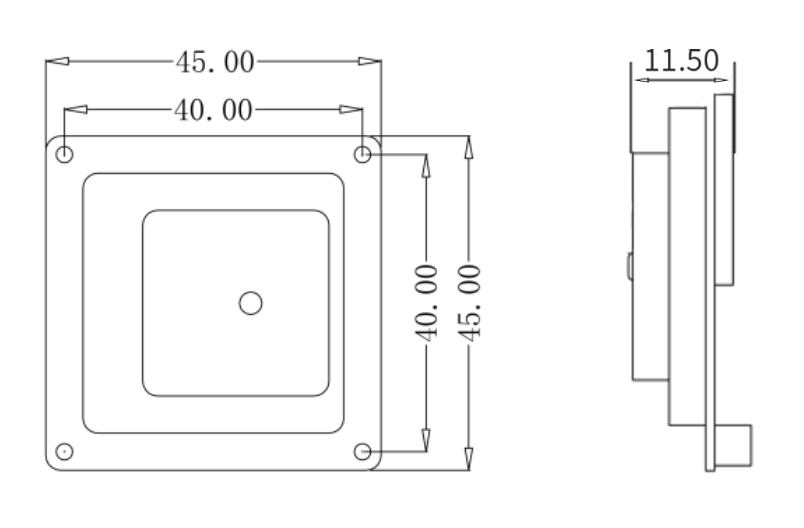
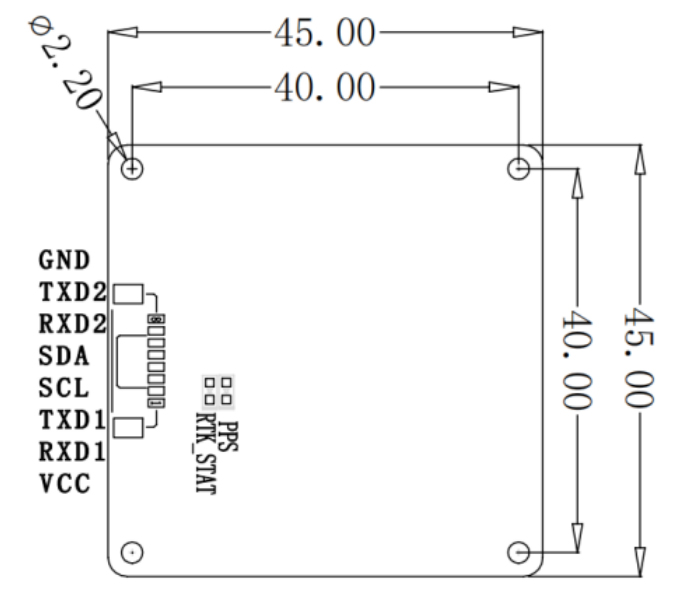
Table 1 PIN Function
|
NO.
|
Signal Name
|
Signal Description
|
|
1
|
VCC
|
Main power supply input, +3.3V to +5V
|
|
2
|
RXD1
|
First serial receive data pin, used for receiving serial date streams.
|
|
3
|
TXD1
|
First serial transmit data pin, used for receiving serial date streams.
|
|
4
|
SCL
|
Clock line in the l2C communication protocol, used for synchronizing data transfer.
|
|
5
|
SDA
|
Data line in the l2C communication protocol, used for bidirectional data transfer.
|
|
6
|
RXD2
|
Serial receive data pin, similar to RXD1, used for receiving another serial data stream.
|
|
7
|
TXD2
|
Serial transmit data pin, similar to TXD1, used for sending another serial data stream.
|
|
8
|
GND
|
Ground pin, used for connecting to the circuit's ground, providing the reference voltage needed for the circuit loop.
|
|
Note: Typically, VCC and GND are used for power supply, TX and RX are used for serial communication, while SCL and SDA are used for I²C communication. These interfaces allow the receiver to exchange power supply and data with external devices.
|
Packaging and Delivery:

Use Scenarios
Precision UAV Navigation and Flight Control
In unmanned aerial vehicle (UAV) operations, the ZED-F9P RTK module for UAV provides essential real-time positioning and heading information for flight controllers managing autonomous missions or manual piloting. Operating in dynamic outdoor environments, this GNSS GPS RTK module ensures centimeter-level accuracy necessary for precise waypoint navigation, stable hovering, and safe obstacle avoidance. Its fast convergence allows drones to achieve reliable positioning rapidly during takeoff, minimizing delay. The module integrates within UAV flight management systems via standard serial protocols, delivering robust localization crucial for tasks such as aerial inspection, survey mapping, and precision agriculture.
Surveying and Geospatial Data Collection
Surveyors and geospatial analysts benefit from the ZED-F9P as a base station or rover in RTK field configurations requiring reliable centimeter-level accuracy. The module’s support of multiple satellite systems enhances signal availability in obstructed or remote survey sites, ensuring consistent measurement quality. Its GNSS module with IST8310 compass assists in orientation-sensitive applications such as infrastructure inspection or cadastral mapping. Capable of interfacing with mainstream surveying hardware and software, the device promotes workflow efficiency in data gathering, directly supporting analyses where high positional and heading fidelity are paramount for results accuracy and compliance with industry standards.
FAQ
What makes your ZED-F9P module suitable for UAV applications?
Our ZED-F9P module combines multi-system GNSS support and centimeter-level RTK positioning with an integrated IST8310 magnetometer, ensuring precise navigation and orientation for UAVs. Its compact size and fast convergence make it ideal for drone flight controllers and autonomous systems.
Can you customize the RTK module to suit specific project needs?
Yes, we offer OEM/ODM customization services for the RTK module and related GNSS products. Our team works closely with clients to adjust firmware, protocols, update rates, and hardware configurations to meet unique application requirements.
What interfaces and protocols does the GNSS module support for easy integration?
Our multi system GNSS module supports TTL serial communication and common protocols including NMEA0183, RTCM 3.3, and UBX. This flexibility allows seamless integration with most mainstream autopilots and navigation systems for enhanced compatibility.
How do you ensure the quality and reliability of your RTK modules?
We apply strict multi-stage quality control, including SMT production, functional testing, and final inspection. DALANG is ISO9001:2015 certified and complies with CE and RoHS standards, ensuring each RTK module for UAV meets rigorous industrial-grade performance criteria.





